Pabington: The Complete Guide to Smarter On-Page SEO and Content Optimization
Creating high-quality content is only one part of successful search engine optimization (SEO). Even the best-written article can struggle to rank if it is not properly optimized for search engines and readers. Factors like content structure, keyword placement, readability, internal linking, and user experience all influence how well a page performs in search results.
This is where pabington comes in.
Pabington is an on-page SEO tool designed to help content creators, bloggers, businesses, marketers, and website owners optimize their content before publishing. Instead of relying on guesswork, the platform provides practical recommendations that improve content quality, strengthen SEO, and increase the chances of ranking higher on search engines.
As Google continues to prioritize helpful, people-first content, optimization tools have become more valuable than ever. Modern SEO is no longer about stuffing keywords into an article. It focuses on creating content that answers user questions, delivers real value, and provides an excellent reading experience.
Pabington supports this modern approach by helping users improve content organization, keyword usage, readability, and overall page quality. Whether you manage a personal blog, an eCommerce website, a business site, or a digital publication, using a reliable optimization tool can save time while improving results.
This guide explains everything you need to know about pabington, including how it works, its features, benefits, best practices, and why it is becoming an important tool for on-page SEO.
What Is Pabington?
Pabington is a dedicated on-page SEO optimization tool that helps users create search-engine-friendly content without sacrificing readability. It analyzes important elements of a webpage and provides recommendations that align with current SEO best practices.
Rather than simply checking for keyword density, pabington evaluates multiple aspects of content quality. It encourages users to create pages that are useful for readers while remaining easy for search engines to understand.
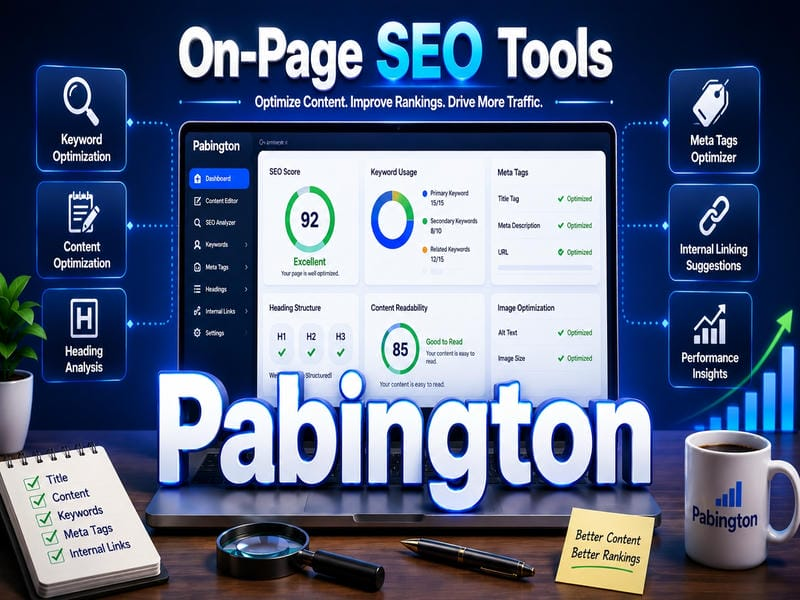
Its primary purpose is to help users publish content that performs better in organic search by improving both technical and content-related SEO factors.
Some of the main areas where pabington focuses include:
- Content structure
- Heading organization
- Keyword optimization
- Internal linking opportunities
- Meta title suggestions
- Meta description improvements
- Readability analysis
- Content completeness
- User experience signals
- Overall on-page optimization
Instead of replacing writers, pabington acts as an intelligent assistant that helps refine and strengthen existing content.
Why On-Page SEO Matters More Than Ever
Search engine optimization has changed dramatically over the past decade.
Years ago, repeating the same keyword multiple times could help a page rank. Today, Google’s algorithms are much smarter. They evaluate content quality, search intent, expertise, usefulness, and user satisfaction.
This means successful websites focus on creating content that genuinely helps readers.
On-page SEO plays an important role because it ensures that valuable content is also easy for search engines to understand.
A properly optimized page typically has:
- Clear page titles
- Well-structured headings
- Relevant keywords used naturally
- Helpful images with descriptive alt text
- Logical internal links
- Easy-to-read formatting
- Fast loading speed
- Mobile-friendly design
- Comprehensive topic coverage
Pabington simplifies this process by identifying areas that need improvement before a page is published.
How Pabington Works
One of pabington’s strengths is its straightforward optimization process. Instead of overwhelming users with technical jargon, it provides practical recommendations that can be applied quickly.
A typical workflow looks like this:
Content Analysis
The first step is evaluating the existing content.
Pabington scans important SEO elements and identifies strengths as well as areas for improvement.
Rather than focusing on a single ranking factor, it reviews multiple components that contribute to page quality.
Structure Evaluation
Well-organized content improves both SEO and user experience.
The tool checks whether headings follow a logical hierarchy and whether sections are arranged in a way that makes information easy to understand.
Proper organization helps readers find answers quickly while making pages easier for search engines to crawl.
Keyword Review
Keywords remain important, but modern optimization focuses on relevance instead of repetition.
Pabington evaluates whether target keywords appear naturally throughout the content.
It also encourages the use of related terms that help search engines understand the topic more completely.
Readability Assessment
Readers rarely stay on pages that are difficult to read.
Pabington examines readability by considering factors such as:
- Sentence length
- Paragraph size
- Word choice
- Heading placement
- Overall flow
Simple improvements in readability often increase user engagement and reduce bounce rates.
Optimization Recommendations
After completing its analysis, pabington generates actionable suggestions.
These recommendations help users improve content quality while maintaining a natural writing style.
Key Features of Pabington
Pabington offers several useful features that support modern content optimization.
Content Structure Analysis
Content organization is one of the most important ranking factors that many writers overlook.
Well-structured articles help readers scan information quickly and encourage longer time on page.
Pabington evaluates:
- Heading hierarchy
- Section organization
- Logical flow
- Content balance
- Readability layout
A better structure benefits both users and search engines.
Keyword Optimization
Modern SEO depends on using keywords naturally.
Instead of encouraging excessive repetition, pabington promotes semantic optimization.
This includes:
- Primary keyword placement
- Related keyword suggestions
- Topic relevance
- Natural language usage
- Search intent alignment
This approach reflects how Google’s algorithms now understand topics rather than individual keywords alone.
Readability Improvement
People do not enjoy reading large blocks of text.
Easy-to-read articles typically perform better because visitors stay engaged longer.
Pabington encourages:
- Short paragraphs
- Clear headings
- Simple vocabulary
- Logical transitions
- Reader-friendly formatting
These improvements create a better overall user experience.
Meta Tag Suggestions
Page titles and meta descriptions influence click-through rates from search results.
Pabington helps users optimize these elements by encouraging descriptive, keyword-focused titles that remain attractive to readers.
Effective meta descriptions summarize page content while encouraging users to visit the website.
Internal Linking Opportunities
Internal links help search engines understand relationships between pages.
They also encourage visitors to continue exploring a website.
Pabington identifies opportunities where internal links may improve navigation and topical authority.
Content Quality Evaluation
Publishing more content is not enough.
Google increasingly rewards helpful content that demonstrates expertise and satisfies user intent.
Pabington reviews content quality by considering factors such as:
- Topic coverage
- Information completeness
- Clarity
- Organization
- Overall usefulness
Benefits of Using Pabington
The value of pabington extends beyond simple keyword optimization. It supports a more strategic approach to content creation.
Improved Search Visibility
Better optimization increases the likelihood that search engines understand the purpose of a webpage.
This can improve organic visibility over time.
Higher Content Quality
Optimization often reveals missing information, weak sections, or opportunities to improve clarity.
The result is stronger content that serves readers more effectively.
Better User Experience
Visitors appreciate content that is easy to navigate.
Clear headings, shorter paragraphs, and logical organization encourage readers to stay longer.
Time Savings
Instead of manually checking every SEO element, users receive organized recommendations that streamline the editing process.
This allows writers to spend more time creating valuable content.
Consistent Optimization
Large websites often publish content from multiple authors.
Pabington helps maintain consistent optimization standards across different articles.
How Pabington Supports Google’s Helpful Content System
Google’s Helpful Content System rewards websites that prioritize people instead of search engines.
This means articles should answer real questions, solve problems, and provide original value.
Pabington complements this approach by encouraging writers to focus on quality rather than shortcuts.
Instead of promoting outdated SEO tactics, it supports practices such as:
- Writing for readers first
- Organizing information clearly
- Covering topics comprehensively
- Using keywords naturally
- Improving readability
- Strengthening topical relevance
These principles align closely with Google’s long-term direction.
Pabington and EEAT
Google evaluates content using the principles of Experience, Expertise, Authoritativeness, and Trustworthiness (EEAT).
Although no optimization tool can automatically create authority, pabington helps users present information in a more professional and organized way.
Experience
Content becomes more valuable when it includes practical knowledge, examples, and real-world applications.
Writers can use pabington to organize their experiences more effectively.
Expertise
Articles should demonstrate a strong understanding of the topic.
Pabington encourages comprehensive coverage that answers common questions and explains important concepts clearly.
Authoritativeness
Well-structured, informative content helps build credibility over time.
Consistently publishing optimized articles can strengthen a website’s reputation within its niche.
Trustworthiness
Clear writing, accurate information, and transparent organization contribute to user trust.
Pabington supports these qualities by helping writers create polished, reader-friendly content.
Who Should Use Pabington?
Pabington is suitable for a wide variety of users who want to improve their website’s on-page SEO.
It can be especially useful for:
- Bloggers publishing informational content
- SEO professionals managing client websites
- Digital marketing agencies
- Small business owners
- eCommerce store managers
- Affiliate marketers
- Content writers and editors
- Freelancers
- Online publishers
- Educational websites
Whether you publish one article each month or hundreds every week, optimizing content before it goes live can improve consistency and long-term search performance.
Common On-Page SEO Problems Pabington Can Help Identify
Many websites fail to rank because they overlook simple but important optimization issues. Pabington helps users recognize these problems before they affect search performance.
Some of the most common issues include:
- Missing or poorly organized headings
- Weak keyword placement
- Thin or incomplete content
- Long, difficult-to-read paragraphs
- Missing internal links
- Duplicate or ineffective meta descriptions
- Unclear page titles
- Poor content flow
- Weak topical coverage
- Low readability scores
Correcting these issues creates a stronger foundation for long-term SEO success.
Advanced On-Page SEO Strategies with Pabington
Creating an article is only the first step toward ranking on Google. To compete with high-authority websites, every page must be optimized from multiple angles. While many people focus only on adding keywords, successful SEO involves improving the overall quality of a page.
Pabington helps users identify these opportunities before content goes live. By following its recommendations, writers can create pages that are more useful for readers and easier for search engines to understand.
Some of the most effective optimization strategies supported by pabington include:
- Creating descriptive and keyword-focused headings
- Improving paragraph structure for easier reading
- Using the primary keyword naturally throughout the article
- Including related keywords to build topical relevance
- Adding internal links to supporting pages
- Writing compelling meta titles and descriptions
- Optimizing images with descriptive alt text
- Covering the topic in greater depth than competing articles
Instead of relying on outdated SEO tactics, pabington encourages improvements that contribute to long-term search visibility.
How Pabington Improves Content Readability
Google wants users to find answers quickly. If an article is difficult to read, visitors often leave the page within seconds. High bounce rates and poor engagement can reduce a page’s long-term performance.
Pabington helps improve readability by analysing how information is presented.
Rather than encouraging long blocks of text, it recommends shorter paragraphs that are easier to scan. It also supports the use of descriptive headings, logical transitions, and clear sentence structures.
Some readability improvements include:
- Breaking large paragraphs into smaller sections
- Using simple language whenever possible
- Organising information in a logical order
- Adding bullet points for lists and comparisons
- Keeping headings descriptive and relevant
- Removing unnecessary repetition
These changes create a better reading experience while also helping search engines understand the content more effectively.
Pabington for Bloggers
Bloggers publish content regularly, making consistency one of the biggest challenges.
Every article should follow the same quality standards while remaining unique and valuable.
Pabington simplifies this process by reviewing each article before publication. Instead of manually checking headings, keyword placement, and readability, bloggers receive clear recommendations for improvement.
For bloggers, pabington offers several advantages:
- Faster content editing
- Better article organization
- Improved keyword optimization
- More consistent SEO practices
- Higher-quality user experience
- Better chances of earning organic traffic
Over time, these improvements can contribute to stronger topical authority and increased visibility in search results.
Pabington for Businesses
Business websites compete in highly competitive search markets. Every landing page, service page, and blog article plays a role in attracting potential customers.
Pabington helps businesses optimize their content so that visitors can quickly understand what the company offers.
It can support:
- Local business websites
- Service providers
- Software companies
- Professional consultants
- Healthcare organizations
- Educational institutions
- Financial services
- Technology companies
Better optimization increases the likelihood that customers find relevant information when searching online.
Pabington for eCommerce Websites
Product pages require more than attractive images and pricing.
Search engines also evaluate page quality, descriptions, internal links, headings, and content relevance.
Pabington can help online stores improve:
- Product descriptions
- Category pages
- Buying guides
- FAQ sections
- Collection pages
- Comparison articles
Better optimization can increase product visibility while providing shoppers with more useful information before making a purchase.
Pabington and Content Marketing
Content marketing depends on publishing valuable information that attracts readers naturally through search engines.
Rather than promoting products directly, businesses educate their audience through helpful articles.
Pabington supports content marketing by encouraging comprehensive topic coverage and better organization.
A strong content strategy usually includes:
- Educational articles
- How-to guides
- Industry news
- Product tutorials
- Expert opinions
- Frequently asked questions
- Case studies
Optimized content is more likely to attract qualified visitors who are genuinely interested in the topic.
Pabington vs. Traditional SEO Tools
Many SEO tools provide technical data, keyword metrics, and backlink analysis. While these features are valuable, they often require advanced knowledge to interpret.
Pabington focuses specifically on making on-page optimization simpler and more actionable.
| Feature | Pabington | Traditional SEO Tools |
| On-page optimization | Excellent | Usually included |
| Content readability | Strong focus | Limited in some tools |
| Easy recommendations | Yes | Often technical |
| Beginner-friendly | Yes | Varies |
| Content structure analysis | Comprehensive | Usually basic |
| User experience guidance | Yes | Limited |
| Technical SEO | Limited | Strong |
| Backlink analysis | Not primary focus | Usually available |
This makes pabington particularly useful for writers, bloggers, marketers, and business owners who want practical guidance without unnecessary complexity.
Best Practices for Using Pabington
Using an SEO tool effectively requires more than simply following every recommendation.
The best results come from combining optimization with high-quality writing.
Consider these best practices:
- Write for people before search engines.
- Focus on solving the reader’s problem.
- Use the primary keyword naturally.
- Include related keywords without overusing them.
- Keep headings descriptive.
- Update older content regularly.
- Add internal links where relevant.
- Review content before publishing.
- Improve pages based on user feedback.
- Monitor performance over time.
SEO is an ongoing process rather than a one-time task.
Common Mistakes to Avoid
Even experienced writers make optimization mistakes.
Pabington helps identify many of these issues before publication.
Some common mistakes include:
Keyword Stuffing
Repeating the keyword excessively makes content difficult to read and can negatively affect rankings.
Instead, use natural language and related terms.
Thin Content
Short pages that provide little useful information rarely perform well.
Aim to answer the reader’s question completely.
Ignoring Search Intent
Every search has a purpose.
A user searching for information expects educational content, while someone searching for products expects buying guidance.
Understanding intent is essential.
Weak Headings
Generic headings make articles harder to navigate.
Clear headings improve both user experience and SEO.
Poor Internal Linking
Internal links help readers discover additional information while strengthening website structure.
Missing these opportunities limits content performance.
The Future of Pabington
SEO continues to evolve as search engines become more intelligent.
Artificial intelligence, natural language processing, and user behaviour analysis now influence rankings more than ever before.
Pabington is well positioned to support these changes by focusing on quality instead of outdated optimisation techniques.
Future improvements could include:
- AI-assisted content recommendations
- Search intent analysis
- Automated topic clustering
- Semantic keyword suggestions
- Real-time optimisation scoring
- Voice search optimisation
- Content gap analysis
- Enhanced competitor benchmarking
As search algorithms continue evolving, optimisation tools must adapt to remain effective.
Expert Insights
One of the biggest misconceptions about SEO is that success comes from using the right keywords alone.
In reality, Google’s algorithms evaluate hundreds of signals, including content quality, expertise, user engagement, page experience, and topical relevance.
Tools like pabington are most valuable when they support—not replace—good writing.
A successful article should:
- Answer the user’s question completely.
- Provide original insights or examples.
- Be easy to understand.
- Stay updated as information changes.
- Demonstrate expertise.
- Build trust through accuracy.
Writers who consistently follow these principles are more likely to earn long-term organic visibility.
Final Thoughts
As search engines continue to prioritise helpful, user-focused content, the importance of on-page SEO has never been greater. Creating valuable information is only part of the process; presenting that information in a clear, organised, and search-friendly way is equally important.
Pabington offers a practical solution by helping writers, marketers, businesses, and publishers optimise their content before it reaches readers. Instead of promoting outdated SEO techniques, it encourages modern best practices such as improved readability, logical content structure, natural keyword placement, comprehensive topic coverage, and a better overall user experience.
Whether you manage a personal blog, a business website, or an online store, investing time in on-page optimisation can lead to stronger search visibility, improved user engagement, and more sustainable organic traffic. While no tool can guarantee a number-one ranking on Google, using pabington alongside high-quality, original content provides a solid foundation for long-term SEO success.
In an increasingly competitive digital landscape, the websites that consistently publish helpful, trustworthy, and well-optimised content are the ones most likely to earn lasting visibility. Pabington supports that goal by making professional on-page SEO more accessible, efficient, and focused on what matters most creating content that genuinely helps people while meeting modern search engine standards.
Frequently Asked Questions About Pabington
What is pabington?
Pabington is an on-page SEO optimisation tool that helps improve content structure, readability, keyword usage, and overall page quality before publication.
Who should use pabington?
Bloggers, businesses, SEO professionals, marketers, content writers, affiliate marketers, eCommerce store owners, and publishers can all benefit from using pabington.
Does pabington guarantee higher Google rankings?
No SEO tool can guarantee first-page rankings. However, pabington helps implement best practices that improve a page’s chances of performing well in organic search.
Is pabington suitable for beginners?
Yes. It is designed to provide practical recommendations that are easy to understand, even for users with limited SEO experience.
Can pabington improve existing articles?
Yes. Updating older content with better headings, improved readability, stronger keyword placement, and enhanced structure can improve overall quality.
Does pabington replace SEO experts?
No. It serves as an optimisation assistant. Human expertise remains essential for creating accurate, trustworthy, and engaging content.